
A Flawless Home from Scratch: A Comprehensive Interior Design & Decoration Guide in 13 Steps
Transform Your Home from the Ground Up
Moving to a new apartment or completely refurbishing your place can bring excitement and anxiety at the same time. Countless color shades in the paint catalogs, the enormous variety in the furniture shops, quickly-changing trends in social media and all the budget constraints can easily give you a headache.
A lot of people think that interior design can be done only by architects or people with a limitless budget. As a matter of fact, good interior design is not about putting together expensive objects – it is about designing a proportioned environment which will fit your lifestyle, provide a soothing experience and functionally suit your needs.
A well-designed room is not an expression of cold perfection but a welcoming environment which greets you the moment you walk in, makes daily life easier, improves communication between you and your significant other, and shows your character. Having the basics in the focus instead of complex jargon makes it fun and simple to create your ideal home.
In this comprehensive guide, we will consider in detail how to deal with blank space, think about the psychology of color, calculate the mathematical relationships between the furniture, illuminate the space, combine textures, and take further steps without going broke.
CHAPTERS
Chapter 1: Confirming the Feel of Your Space
Chapter 2: Finding Your Style in Interiors
Chapter 3: Spatial Planning Prior to Purchasing Your Furniture
Chapter 4: Mastering Color and Natural Light
Chapter 5: Scale, Proportion, and Selecting Appropriate Furniture
Chapter 6: How to Lay out Functional Spaces and Circulation
Chapter 7: Layered Lighting Design
Chapter 8: Adding Texture, Patterns, and Visual Interest
Chapter 9: Thoughtfully Placing Art and Accessories
Chapter 10: Biophilic Design to Introduce Nature Inside
Chapter 11: Practical Budgeting along with Savvy Shopping
Chapter 12: Common Mistakes Made by Novice Designers and How to Avoid Them
Chapter 13: Zoomed-in Strategy
Conclusion: An Authentic and Unique Home
Chapter 1: Confirming the Feel of Your Space
A major blunder repeatedly made by a novice designer is to jump straight into selecting furniture or wall colors. It’s worth noting that the first step to a professional design process is not a collection of things but rather a feeling.
Dealing with Feelings
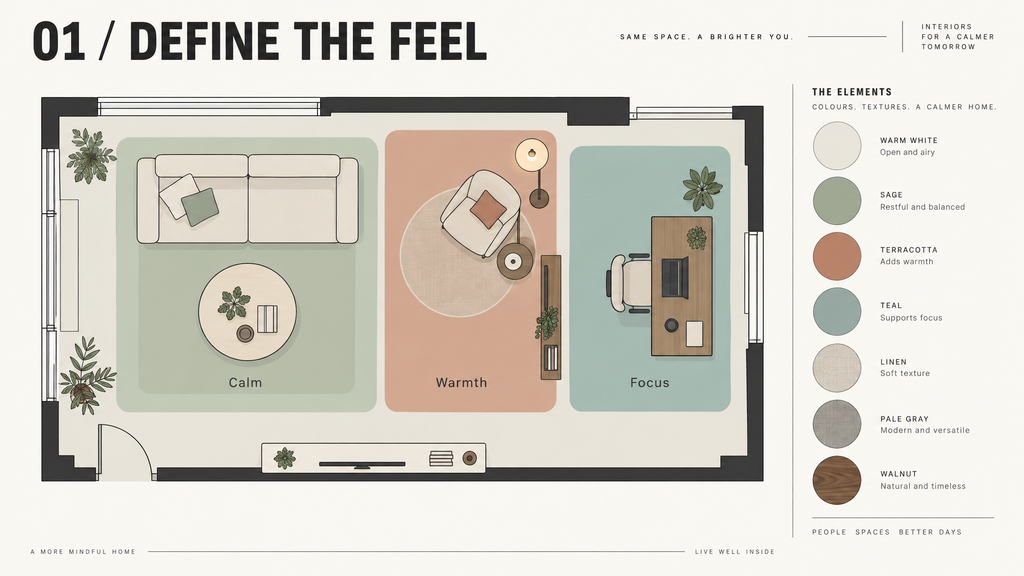
The design process should take off with this important question: How do I want to feel in this space?
The dominant feeling that one wants to evoke in every specific space can vary.
- Peace and tranquility: This is what one should want in the bedrooms or any other space intended for resting. Ghery, for example, creates the right atmosphere through gradual transitions, color contrast and the use of absorbent materials.
- Warmth and intimacy: If it’s a living room or dinning area that you’re trying to design, you would probably want to create a welcoming atmosphere through the use of wooden materials, dim light and cozy fabrics.
- Concentration and clarity: This kind of environment can benefit any home office and should stem from organized and clean lines of your office.
- Enthusiasm and excitement: I wouldn’t exclude cooking and entry-flow spaces from such expressions.
Prioritizing Your Lifestyle and Function
A space is not only meant to be visually appealing but also allow you to go about your daily life in an enjoyable manner. Think carefully about the people living in your space, how often do kids or pets come into the room, do you work in the space, and whether you throw a lot of parties or not, etc. An expensive silk couch is something that looks fabulous in magazines, but it is definitely not fitting for a house with small children or a cat that loves to scratch everything.
Thinking from the perspective of your lifestyle will help you make functional and lasting choices that you will not regret.
Reflecting on Your Existing Space: Noticing What Works
Whenever possible, do not feel overwhelmed, and be sure to take full advantage of your existing space:
- Where do I spend most of my time in the room?
- When does the light come and from where?
- Which items make a room feel tight, or they block pathways?
- Where do all the messier things accumulate?
Once you realize what kind of work functions well in the room and what does not, the goals defined for your space will become clear.
Steps to Make a Mood Board
One of the best methods of making your ideas for interior design real is by making a mood board. You can use online tools such as Pinterest or Canva or you can simply go for a physical board, such as a chalkboard or a corkboard and collate together interior pictures, pieces of fabric, paint swatch cards, flooring textures, and furniture pieces that stimulate your creative taste.
While making your mood board don’t focus on each separate piece but rather think through the discussions that they have with each other. Seeing how well an oak coffee table fits together with the velvet sofa fabric can help you avoid unwanted buys.
Chapter 2: Finding Your Style in Interiors
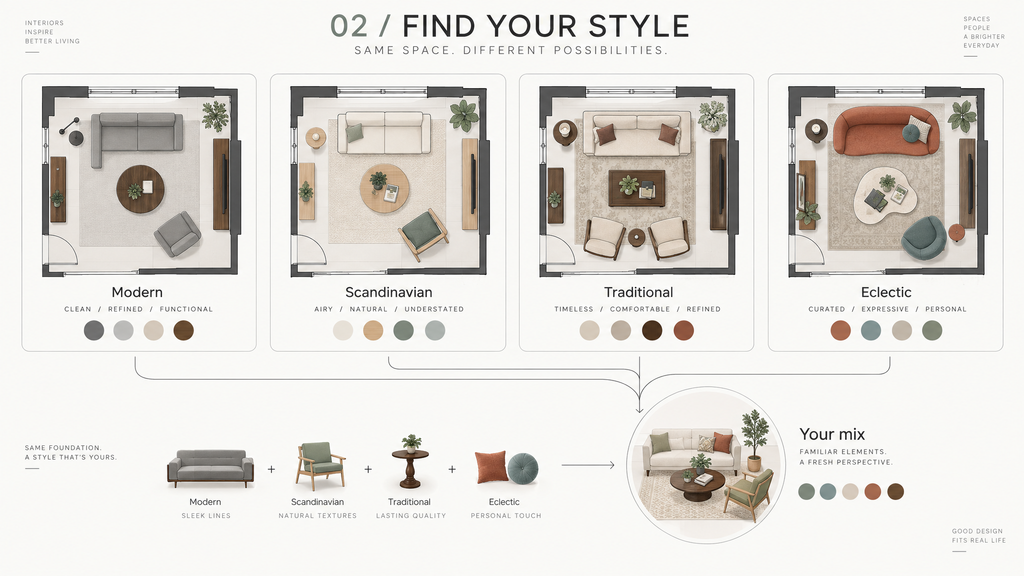
In interior design, styles are not rigid and are not defined by strict lines. Styles are merely pointers that will assist you in realizing your individual preferences and style.
Popular Styles in Interiors
Before determining your own style, it is advisable to know the principal characteristics of the major styles:
- Modern: Characterized by simple vertical and horizontal lines, geometrical shapes, metal furnishings, and functionality.
- Minimalist: Based on the principle that “less is more.” This type of style emphasizes only the most necessary and functional pieces and treats the lack of them as a part of the style.
- Scandinavian: Features a lot of light natural wood, gray and white colors, a lot of natural light, useful furnishings, and coziness, which is a unique feeling of intimacy.
- Traditional: Distinguished by rich wood accents ornamented with molding, symmetry, rounded shapes, classic pieces, and fine textiles.
- Transitional: Combination of the elegance of the traditional style and simplicity of the modern design. A sofa in traditional style can be matched with a metal table in modern design.
- Industrial: Exposed brick and ventilation pipes, rough wood, and metal, as well as industrial decorations belong to this style.
- Coastal: Associated with the sea due to its light colors (white, beige, or blue), natural materials and an atmosphere of airiness.
- Eclectic: Rational combination of different styles and materials..
Finding Patterns in Your Choices
Now, think back to all of the images you saved. Are there a lot of wood textures? Do you like high contrast black-and-white designs? Do you prefer the curves, or do you love the sharpness of the geometric shapes? The similarities that appear in your choices represent the most important aspects of your style.
Differences Between Trends and Timeless Design
Every micro-trend that has been applied in interiors and has been put on social media, like very bright neon accessories or wavy forms connected to a particular period, might not look good in your house for many years.
The best strategy would be to utilize timeless quality pieces to create a base of the room, like large furniture and floor, wall color, etc. Only after you have built up the foundation based on design principles, you can suggest using temporary trends in the form of easily changeable accessories like cushions, vases, candleholders, etc.
Design Based on Your Home’s Architecture
Ceiling height, window sizes, historical features, and modern construction, will affect your decisions while designing your interiors. For instance, a historic apartment with high ceilings is perfect for traditional moldings, while a small studio apartment with a low ceiling would require minimalistic shapes and openness visually.
Chapter 3: Spatial Planning Prior to Purchasing Your Furniture
Showrooms and furniture shops usually contain rooms with very tall ceilings and spacious storage. The sectional sofa that appears stylish and minimalistic in a showroom can appear very immense and gargantuan in a regular living room. Therefore, measuring should never be optional; you need to measure your space.
Important Measuring Guidelines
Get your tape measure and write down all the important details:
- Length of all the walls and the height of the ceiling.
- The direction of the doors that you know and the swing of the doors.
- The width of the windows, the height of the window above the floor, the space between the windows and ceiling above the windows.
- The location of all the electric outlets, light switches, cables, radiators, and air conditioning vents.
- The size of the hallways, elevators, and doorways of your buildings.
Drawing a Simple Floor Plan and Circulation Areas
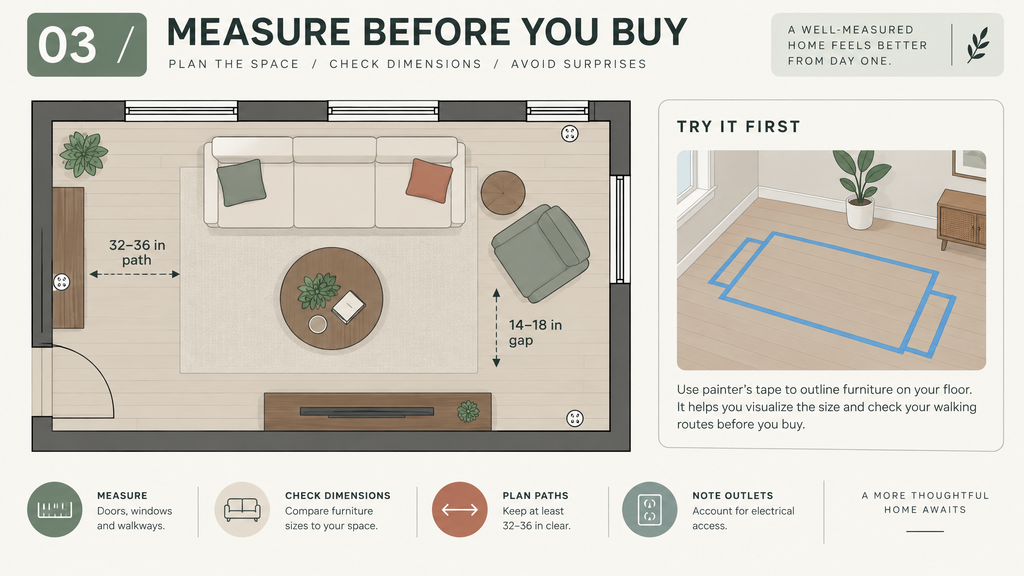
Use graph paper to sketch a basic plan of your room based on a scale, e.g., 1:20 or 1:50. Remember the following basic regulations regarding off-the-wall circulation paths:
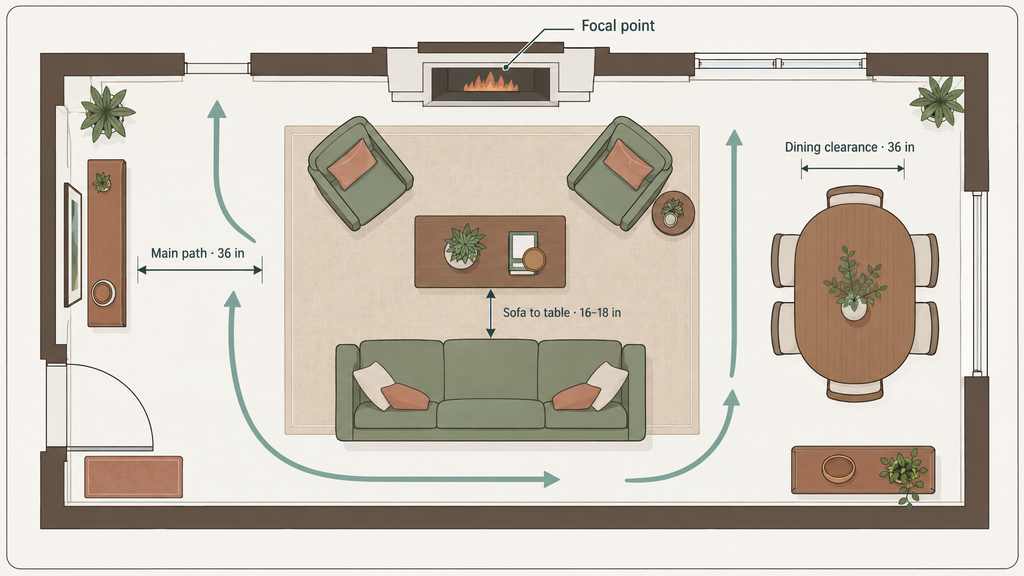
- All paths should usually be at least 32–36 inches wide.
- There will be a space of around 14–18 inches between a coffee table and a couch for comfortable sitting and circulation.
- And at least 36 inches should remain free along the edge of the table around a dining table for easy movement of chairs.
Identifying the Focal Point
Every good room has a hero that is attractive to the eye—the main element that will catch one’s attention first and act as an anchoring point for the entire design. A focal point will be either:
- An architectural fireplace,
- A large window showing something interesting,
- An accent color wall, or a wall decorated with a large piece of art,
- Or an elegant built-in shelf.
The entire interior of the room will revolve around and support that one main element.
Testing Dimensions with Painter’s Tape
Once you have chosen a piece of furniture, take some painter’s tape or a piece of paper and arrange it on the floor according to actual dimensions to see how the sofa, table, console will work among the other things.
Chapter 4: Mastering Color and Natural Light
Color is one of the strongest aspects of design, as it is capable of altering the feeling of a room in seconds. A skillful selection of colors can make a disorderly room orderly, open the sight of a lower ceiling, or make a cold room feel warmer.
Balance Using the 60-30-10 Rule
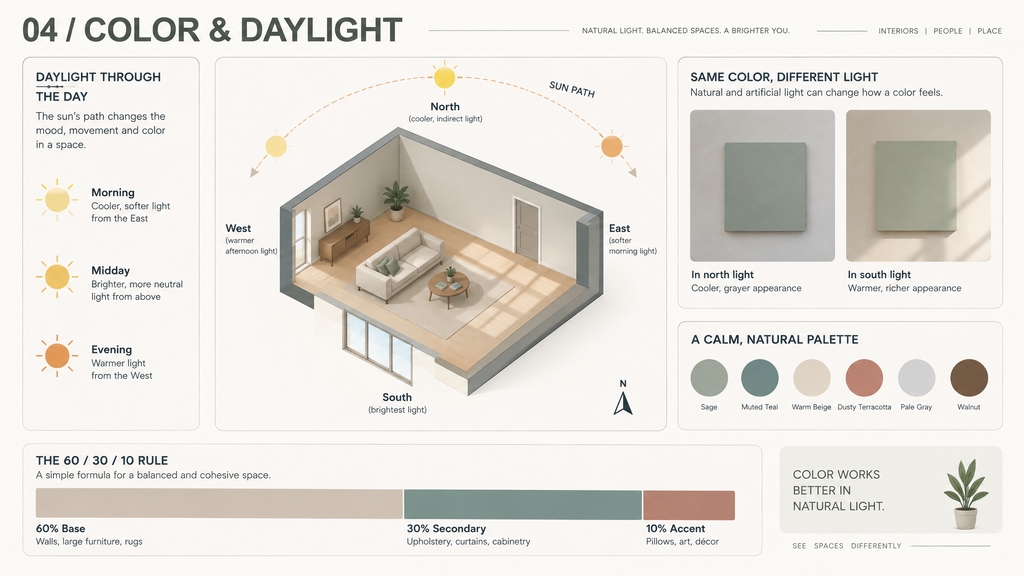
The 60-30-10 rule is one of the best-known rules that the majority of interior decorators use:
- 60% Base Color: It constitutes a dominant base of the room, which is usually used for walls, large rugs, or the largest object of furniture. Generally, they are selected among neutral, muted, and soft colors;
- 30% Secondary Color: This color differentiates the room and gives it character. It can be painted on curtains, bedspreads, or fitted furniture;
- 10% Accent Color: This color adds energy and motion, thanks to its brightness or contrast. It can be used in pillows, paintings, flower pots, and minor lamps.
Effect of Natural Light on Color Temperature
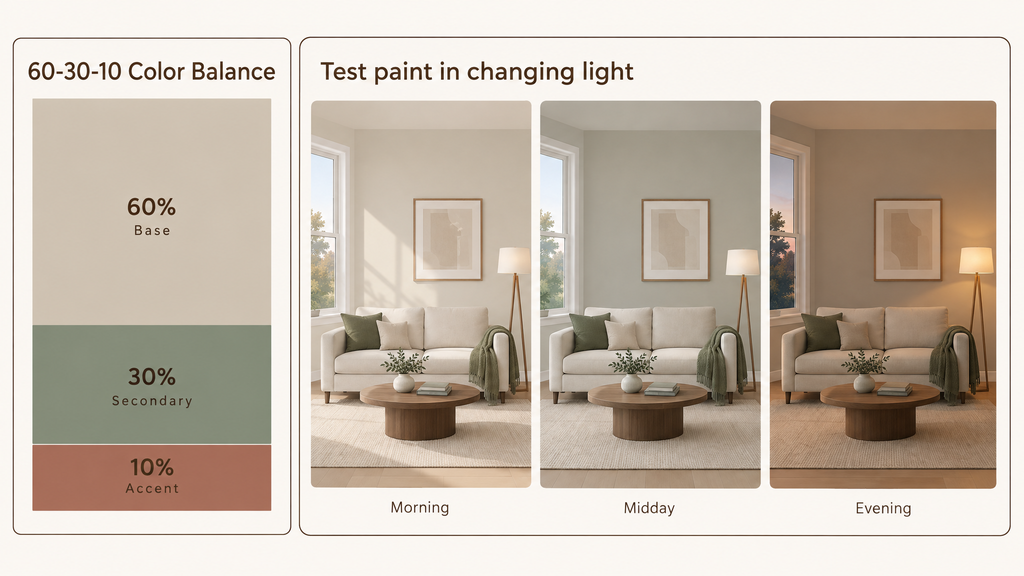
The way the paint color appears on your wall is influenced by the natural light:
- The rooms with North exposure: Such rooms receive a cool bluish daylight. Because of that, the walls painted in gray or cool white colors may look too dull. Therefore, warm colors like beige, cream or some soft earthy tones will more likely fit here.
- The rooms with South exposure: In houses with South-facing rooms, warm sunlight floods the entire space. Yellow tones may feel too weighted here, while cooler grays, sage greens and light blues will suit.
- The rooms with East and West exposure: Such rooms get intense golden light in morning or evening hours, but they can remain shaded some part of the day. Neutral tones will be preferable choice.
How to Test the Colors of Paint
Never limit yourself by relying completely on small color samples. Buy a small sample pot of the chosen paint and test it at least in a 20 × 20 inches area, applying at least two coats of paint on it. Observe the color for at least 24 hours in morning sunlight, midday hours and artificial light.
Creating Color Rhythm and Continuity
Your house is not simply a number of isolated boxes. Create harmony and continuance using colors in the house. For example, rich shades of green may be used in the living room and then they will smoothly appear in the end of the living room.
Chapter 5: Scale, Proportion, and Selecting Appropriate Furniture
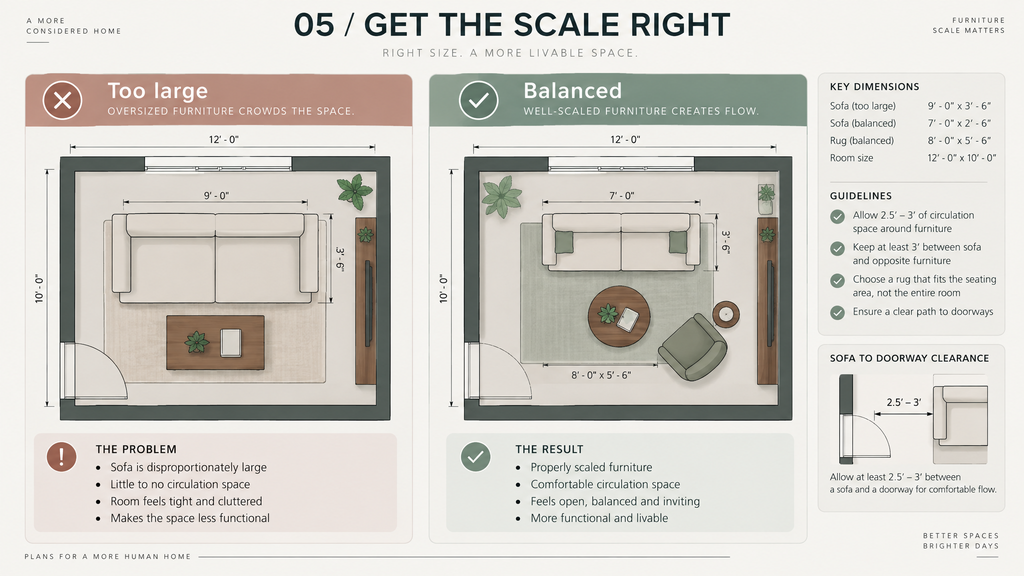
Often the difference between a well-dressed room and an awkward one comes down to scale and proportion. Scale is the size of an object in relation to the room, while proportion is the relationship between objects.
Scale and Proportion Basics
A large couch can make a small room feel narrow, but oftentimes we go to the other extreme and put many little pieces into the small room. Then we have a different problem called visual noise. It’s better to use the right scaled main pieces and to use larger forms versus lots of little pieces.
Balancing Visual Weight
Visual weight refers to how heavy something feels in a room. A big solid-hickory cabinet on the floor has great visual weight. To offset it, you would want to balance it with lightweight forms like chair legs of metal or raised with open space underneath.
If you stack all of your heavy furniture on one side, you will have lost visual balance, too.
Directing Focus to Buying Online Furniture
When it comes to spending your budget and time on furniture, start from the base:
- Core Furniture Items: Those items you will be using the most and that you require comfort, such as your primary couch and bed.
- Utilitarian Furniture Items: Such as coffee tables, consoles or nightstands.
- Style-Enhancing Furniture: Such as accent chairs, side tables, and ottomans.
Set of Questions to Ask Yourself before Buying Online Furniture
- Are the sizes appropriate for the doors, pathways, and ceiling heights of your room?
- Is the material appropriate for the kind of regular use that you will put it to, and for your routine cleaning?
- Will the height of the back rest obstruct view from the window?
- Will the depth of the sofa or chair be suitable for your body size and the way you intend to use the sofa or chair?
Chapter 6: How to Lay out Functional Spaces and Circulation
When you start furnishing a room, most common reaction is to move everything against the walls. Even though it is considered a good practice to leave the whole room empty, people can feel like they are in a waiting room.
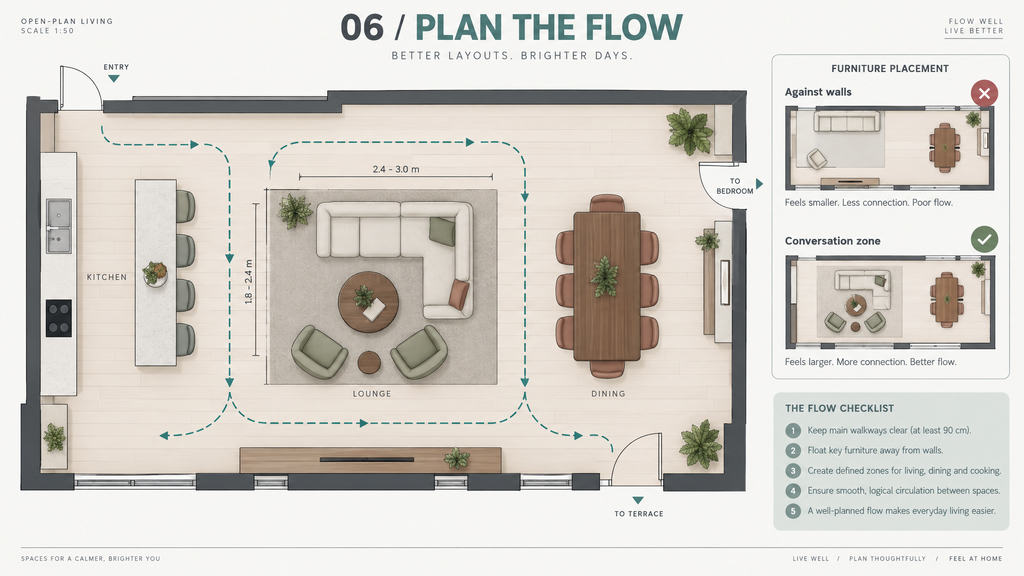
Pulling furniture away from the wall
If the dimensions of the room allow for so, then at least 6–8 inches away from the walls, you should shift chairs or sofas. Floating the furniture towards the center of the room makes it more spacious and provides better sense of circulation and closeness of conversation area.
Conversation areas
The main goal of a living room is to be gathered with your loved ones. Sofas and chairs should be placed in such a way that people would not have to shout. Ideally, all seating places should be in the maximum conversation areas no more than 8–10 feet in diameter.
Designing Open-Plan Lounge
It is possible to establish boundaries in areas where the living area and kitchen are part of one open area. Some of the ways to create divisions through design are:
- Rugs: One of the most conspicuous ways to separate areas of activity, for instance, dining area and sitting area.
- Lighting: A pendant light directly above the dining table creates one clearly defined area.
- Furniture Backs: Placing a low console behind a couch can act as a stylish separation between the entry way and the lounge.
Providing Clearance for Doors and Drawers
When positioning furniture consider the use of the furniture, not just the state without drawers and doors:
- Provide 36 inches in front of wardrobes and cabinets for doors to swing open
- Provide around 39 inches for the opening of the oven and dishwasher doors
- Ensure drawers are opened fully and do not disrupt the circulation.
Chapter 7: Layered Lighting Design
An overhead light source alone is not enough to create a warm feeling, even if your furnishings are high-end. Lighting also accounts for the functionality of a space, as well as adds to the emotional depth and creates warmth in an overall design scheme.
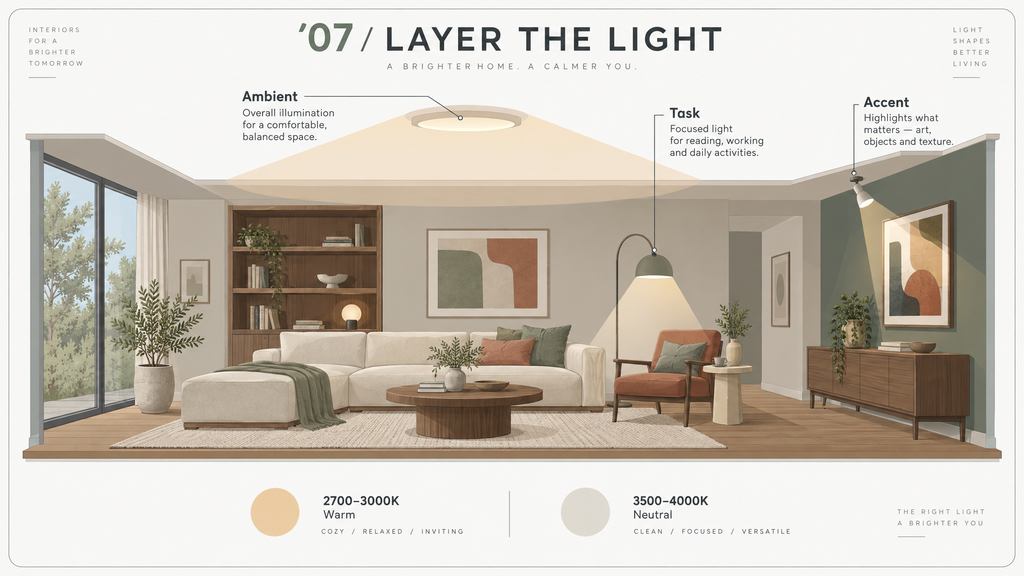
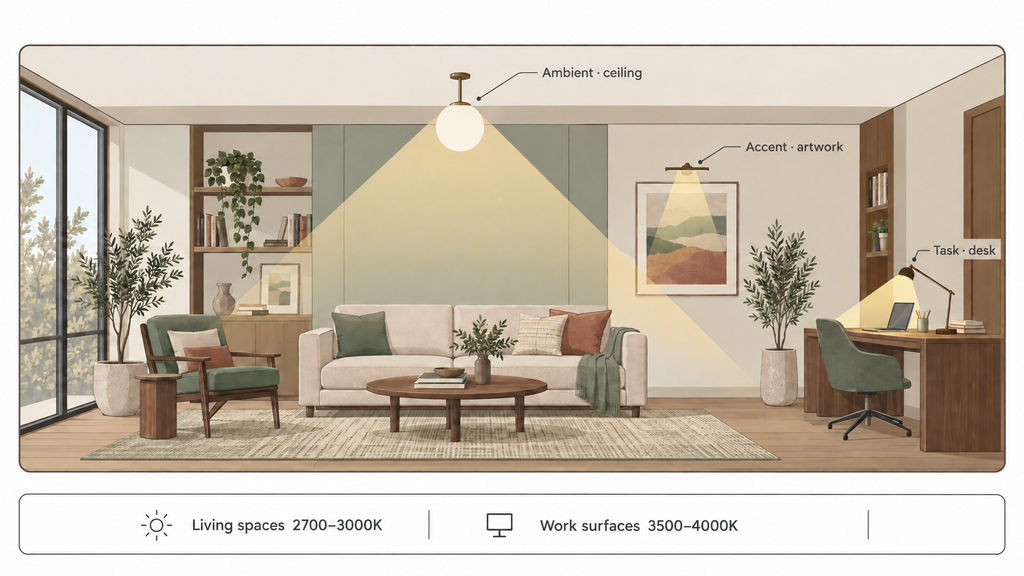
Lighting for a Room should always have three Different Types of Layers – Ambient, Task and Accent Lighting.
The Types of Light can be defined as follows:
- Ambient (General): Ambient Lighting is the brightest source of light within a room. It allows for safe navigation throughout the room. Ambient Lighting can be Recessed Lighting, a Ceiling Fixture, or even Hidden LED Strip Lighting.
- Task (Specific): Task Lighting is more concentrated than Ambient Lighting (typically). Task Lighting is used only when performing a certain task(s). Example = Desk Lamp for writing at your desk.
- Accent (Showcase): Accent Lighting is meant to enhance the beauty of something. You use Accent Lighting on the Artwork, Plants, Shelves etc. by using Track Lighting or Picture Lighting, or another fixture appropriate for highlighting something.
Kelvin Value and Color Temperature
The color of the light has a big impact on the mood in a room:
- 2700K-3000K, Warm White: Best suited for living rooms, bedrooms and dining areas. Provides a relaxing, cozy and comfortable feeling.
- 3500K-4000K, Neutral White: Good for kitchen countertops, bathrooms, and home offices and makes colors appear as natural as possible and generates a lively atmosphere.
- 5000K and higher, Cool White: Usually better not to use in homes as it gives an uncomfortable, clinical feeling like a hospital room.
Turning to Dimmers
You should use dimmer switches whenever possible, because this will allow you to have bright light when you are cleaning during the day and switch to a lower one when you are relaxing or having dinner at night.
Placing Mirrors to Spread Natural Light
Whenever the room does not have sufficient natural light, you should put a large mirror opposite or diagonally across the window. This way, the mirror will be able to catch the natural light arriving from the window and reflect it much deeper into the room.
Chapter 8: Adding Texture, Patterns, and Visual Interest
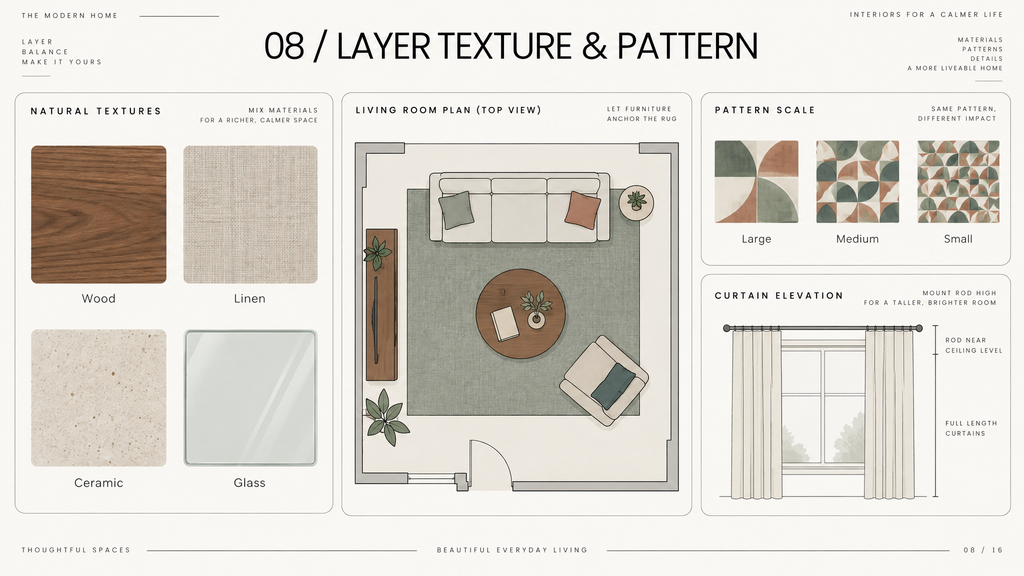
Sometimes, a room has shades that work, and the dimensions of the furniture are right, yet it still looks dull and lifeless. The problem is usually the absence of texture. Texture can be understood as physical contact with an object or a physical appearance of something.
Creating Warmth through Different Types of Materials
Using only one type of material for a room, makes it rather boring. If you want to achieve a more interesting atmosphere, after different textures:
- Smooth and shiny, e.g., glass, mirrors, polished marble, and chrome.
- Mat and rough, e.g., raw wooden, brick, concrete, and travertine.
- Soft and warm, e.g., bouclé, linen, wool, velvet, and fluffy fabrics.
Just putting a rough ceramic vase on a polished marble coffee table, paired with linen curtains, creates an interesting contrast.
Selecting Rugs and Defining the Space
The rug serves as a unifying piece of furniture:
- The Biggest Mistake: Selecting a rug that is small so that it is an isolated piece of furnishing (like a stamp).
- The Good Rule: For the living room, at least the front legs of the couch or chair should be on the rug and since ideally, you should have one big enough to cover the major pieces of furniture. In the dining room, the rug must also be under the chairs, even when they are moved away from the table.
The Design Significance of Draperies
The drapes provide privacy in addition to highlighting the height of the ceiling:
- You should position the curtain rod/track as high as possible to the ceiling, instead of placing it just above of the window.
- You should extend the width of the drapery by 8–12 inches from each side of the window frame. This way when opened, the glass will be visible, making the window seem bigger.
- Curtains should either touch the floor or have a little soft break. Short curtains which look like they are hanging don’t help, rather make the room visually shorter.
Pro Guidelines to Designing Patterns
Pattern designing can be daunting for novice designers. You have taken a step to lessen the anxiety by creating a 3 grid set up:
- The Large Pattern: Usually utilized by either carpets or special draping for curtains featuring large geometric or organic designs.
- The Medium Pattern: Employed for upholstery, sofa covers, or similar kind of fabric using chequered, striped or medium-sized printed patterns.
- The Small Pattern: Used in smaller home decorative accessories like cushions and small jars with small floral designs or dotted designs.
Chapter 9: Thoughtfully Placing Art and Accessories
Accessories and art are the embellishments of a home, but if not done right, these can bring disturbances to the overall view and make the room feel crowded.
The Best Way to Hang Artwork
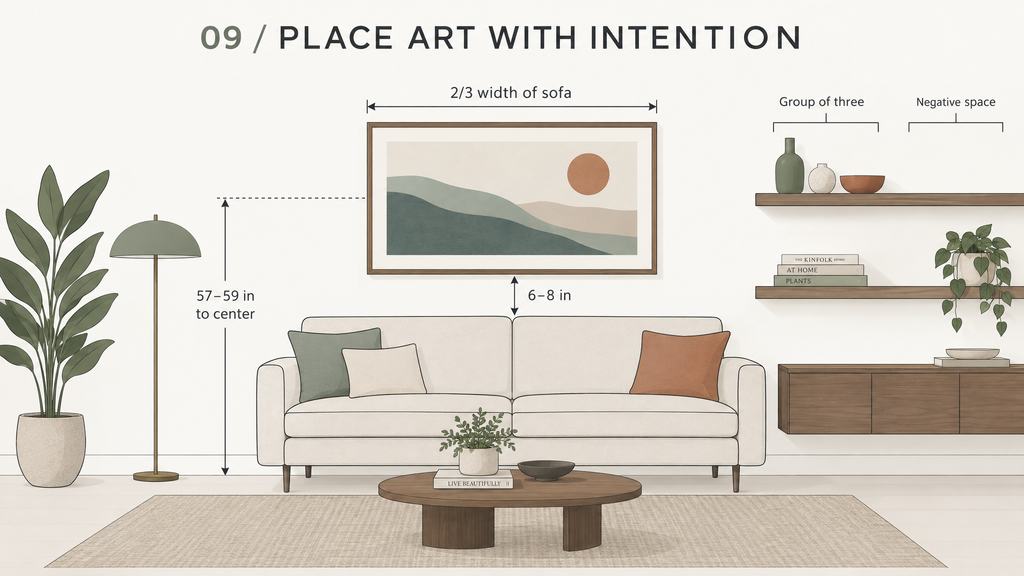
Follow the universal gallery and museum guideline for your own home:
- Hang the artwork’s middle to be about 57–59 inches from the floor.
- Place the artwork about 6–8 inches above the sofa or console.
- The width of the artwork should be approximately two thirds of the width of the underneath furniture.
How to Create a Gallery Wall
Hanging multiple frames can be troublesome, so spread a piece of kraft paper on the floor, arrange the frames over it, outline them, and stick the paper on the wall. You should leave about 5–8 cm between the frames to standardize the space.
The Rule of Threes and Layering
The eye seems to react positively to odd numbers, having a preference for groups of three over groups of four, for instance, when arranging coffee tables or consoles:
- Use three objects of three different heights e.g., a tall candlestick, a shorter vase, and a bowl.
- Use different forms such as vertical, horizontal and round shapes
- Use vertical and horizontal layers such that books are on horizontal levels and a decorative object can be placed on top.
The Importance of Negative Space
Negative space or the space or gaps around the objects is equally as important as the objects themselves. You don’t need to fill every coffee table, or every wall or shelf. The empty spaces allow the beauty of what you are displaying come out.
Natural Materials Provide Tactile Richness
Look to use only natural materials instead of synthetics (or plastics):
- Solid woods: oak, walnut, ash
- Rattan and basketry
- Linen and basic cotton (unbleached)
- Travertine, marble, and handcrafted ceramics
Natural materials age and improve with age, giving character to a room and providing authenticity.
Creating Organic Shapes to Soften Modern Rooms
Modern rooms can feel excessively cube-shaped. This can be resolved by using organic shapes to add softness. Examples include; coffee tables that are circles rather than rectangles; mirrors that are curved instead of straight; floor lamps that have an arc to them rather than being vertical. These will help to break up straight lines while providing a visual guide for the eye through the room.
Chapter 10: Biophilic Design to Introduce Nature Inside
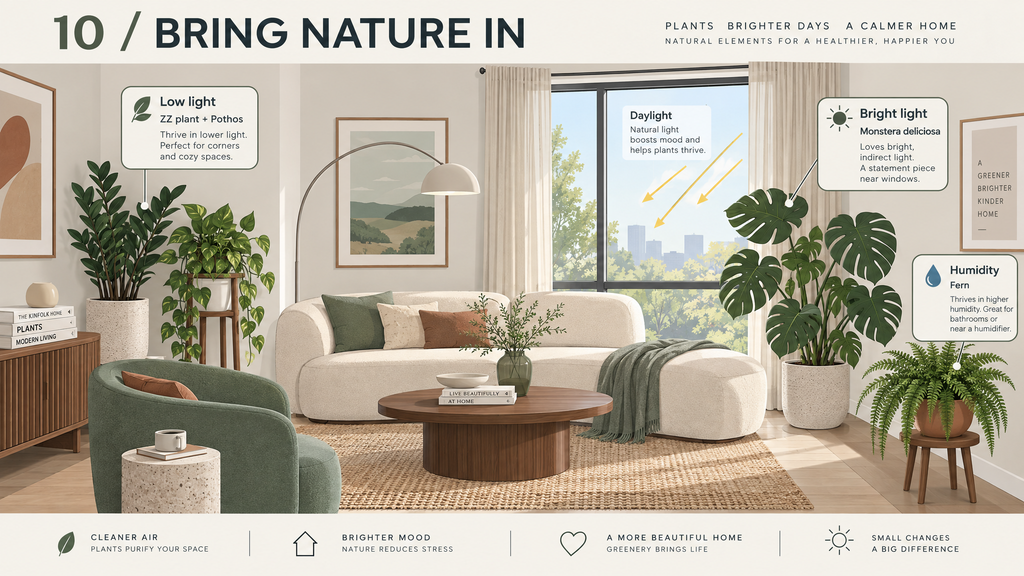
Biophilic design introduces nature into buildings often referring to the bond humans have with the outdoors which can contribute not only a decorative element but also a sense of tranquility and freshness of any place.
Selecting Appropriate Plants for Indoor Use
Plants add vitality and natural color to any space. Select according to the light you have access to:
- For Dark Areas: Dengy plants like ZZ plant, snake plant, dumb cane and pothos. These types are hardy plants that thrive in very little light.
- For Brighter Areas: Ingredients like monstera delicious, fiddle-leaf fig and areca palms.
- For Areas with High Humidity: Use ferns and orchids as both require higher humidity.
Chapter 11: Practical Budgeting along with Savvy Shopping
Designing an aesthetic home doesn’t require an expensive budget. It requires smart financial management in the limited budget you have.
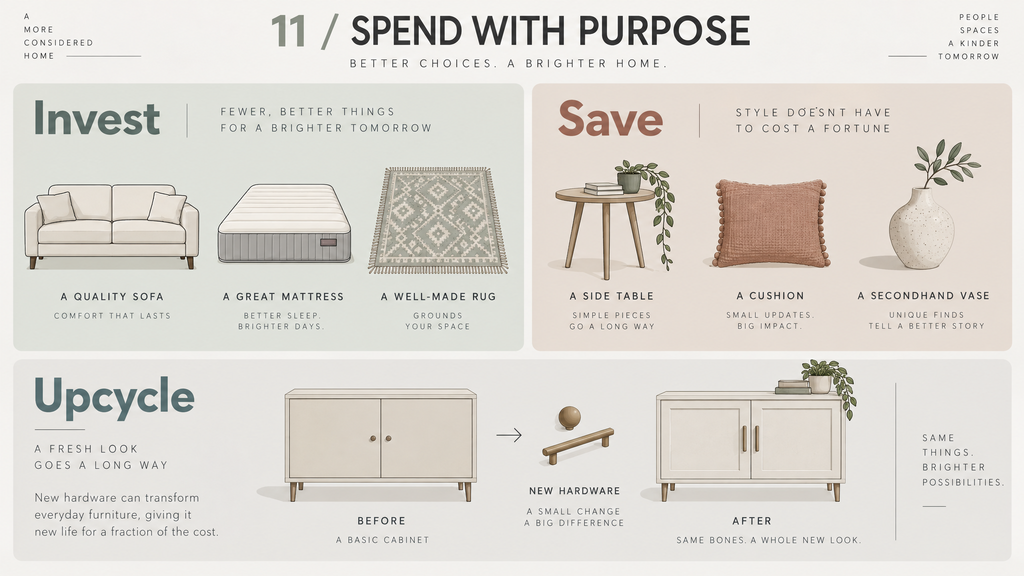
Budget Allocation Matrix: Where to Splurge and Where to Save
| Things to Splurge on | Things to Save on |
| Sofas and Sections: The type of cushion and frame quality directly affect the comfort level. | Side Tables and Coffee Tables: Budget options often look good enough. |
| Bed and Mattress: These should never be compromised as these are vital for a good night’s sleep. | Cushions: These can be changed easily as per the season. |
| Main Lighting Source: This gives you an overall idea of the room. | Accessories and Artwork: You can easily find second-hand or DIY options. |
| Area Rug: You should invest in durable and stain-resistant fabrics. | Decor Objects and Candle Holders: You can easily find budget shops. |
Creative Upcycling and Repurposing Projects for Your Home
Don’t dump your old furniture just yet, here are some ideas for simple projects:
- Replace your old hardware on your sideboard / side table with a new set of matte black or brass knobs.
- Sand down your wood table and apply a matte finish to achieve a modern Scandinavian design.
- Add decorative trim or molding to any plain-looking wall to give it instant visual interest.
The Magical Qualities of Using Thrifted Items
A house decorated with a catalog-inspired theme can look cold and uninviting. To create an atmosphere that is welcoming and warm, consider incorporating at least one unique vintage piece (e.g., an old/worn arm chair, solid wooden console, or brass sconce) into your decor scheme. This will not only will provide visual contrast against the faceless look of all of your mass-produced home decor items, but will lend a character to your space instantly.
Chapter 12: Common Mistakes Made by Novice Designers and How to Avoid Them
Mistakes are a great teacher, but it is better to learn from others’ mistakes so as to save your time and resources.
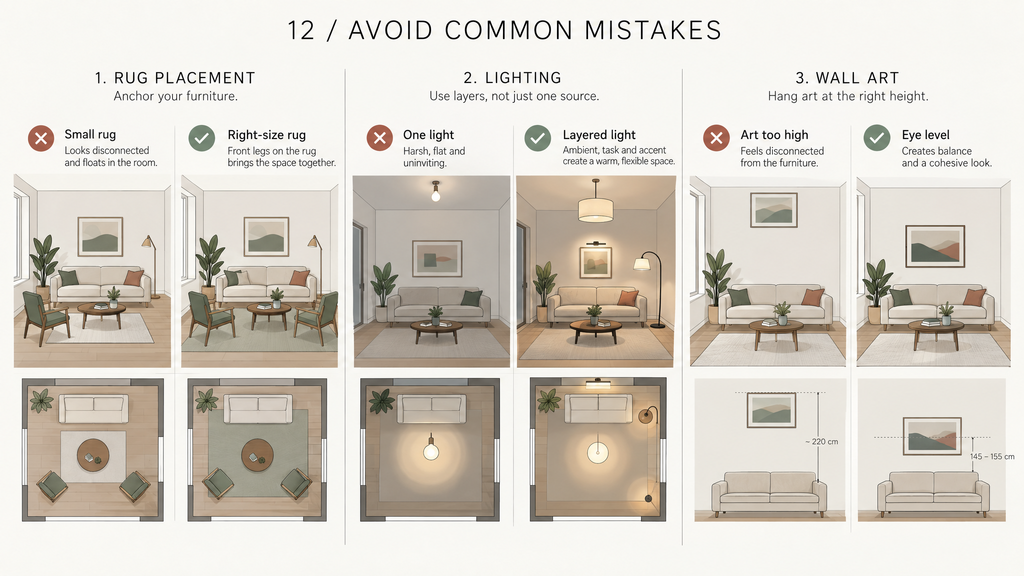
1. Buying without Measurements
The first blunder and the most typical in the interior design sphere is to purchase furniture item you like from the store completely ignoring the measurements.
2. Buying Sets of Furniture
Purchasing the set of a couch, a couple of chairs, a coffee table, the dining table and maybe a console from the same manufacturer makes your house look like a showroom. It is better to create an appealing interior design by combining pieces of furniture from different times and styles.
3. Using One Kind of Light Source
Relying on one ceiling lamp creates dull impression of the whole room. In addition to the ceiling lamp, you should include table and lamp stands to illuminate the room at eye-level and on the floor level.
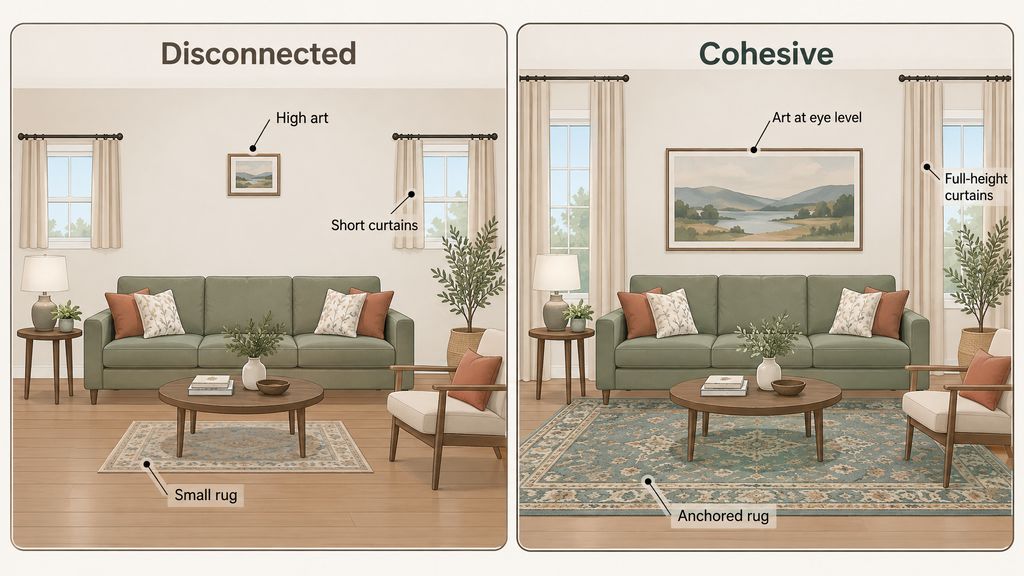
4. Rugs of Small Size
Using a small rug in the room to cover floor creates the impression of even smaller room and the furniture appears disconnected. Rugs should cover all seats in the seating hemisphere.
5. Curtains at the Window Frame
Hanging curtains at the window frame makes ceiling look lower than it is.
6. Art too High on the Wall
You should not hang art so higher as to make it look low. The appropriate level of the artwork center is close to 57–59 inches from the floor.
7. Filling in All Empty Space
Let your home breathe and allow the spaces to be free and calm.
Chapter 13: Zoomed-in Strategy
Renovating a home completely at once will deplete your finances and your mental energy. You should focus on the area you spend most of your time in, likely your living room or bedroom. Start with the basic layout and focal point first, and then live in the place.
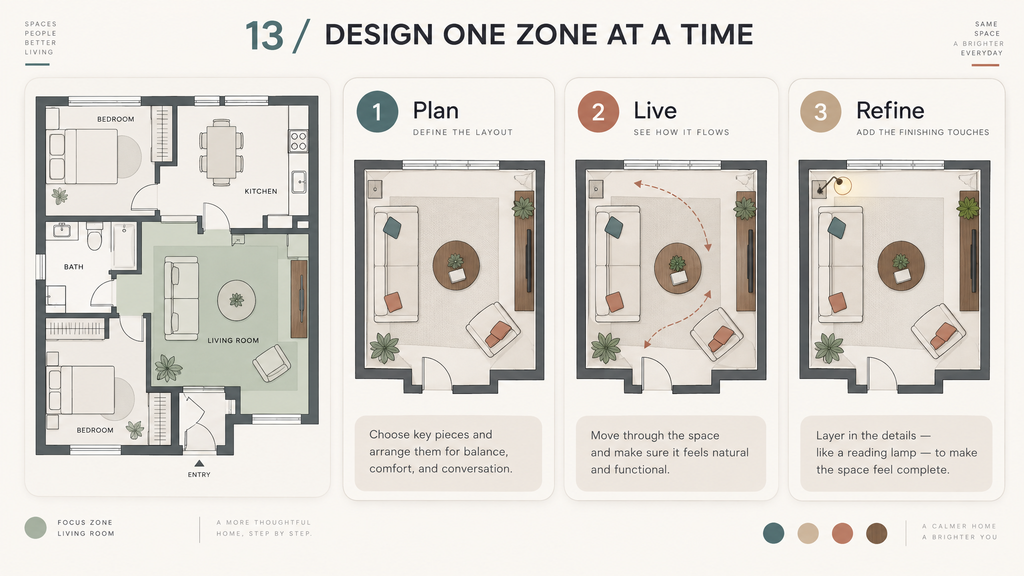
The Importance of Living in the Place
You won’t be sure where you need a reading light, where the most convenient spot for your morning coffee is, or how much storage space you actually need until you have lived in that corner for several weeks. You will discover the best decorating decisions through experiential learning.
The Progress of a Home
Design is not always a final form. Memory, gifts, meaningful art, and pieces you pick up will change your home over time.
Conclusion: An Authentic and Unique Home
When first learning how to engage in interior design, keep in mind that this is not an exact science that you need to master through study. It is very simple: measure your room accurately, choose your desired mood, decide on a color scheme, pay attention to the scale and proportions, and light your room with different layers.
When you start decorating your home, think not about making it look lovely without any thought for your well-being but about enriching your life with the true reflection of your personality and warmth you can find everywhere in your space.
It is important to understand that the best home is not one that looks well in magazines, but rather one that has your story told in it. Try to be calm, do everything in your own pace, and enjoy every step of turning it into a truly yours apartment.